

 |
 |
 |
 |
 |
Burn Masks

3D Scanning
 |
 |

Products
 |
 |
 |
 |

Information
 |
 |
 |
 |
 |
 |
 |
 |
 |

Quantification of Whole Body Surface Area Using 3D Scanning

©2008 Total Contact - All Rights Reserved
A number of regression equations are used for calculating total body surface area for the burn patient, however, these formulas differ greatly in resulting surface area estimates. Lund-Browder charts are based upon such estimates.
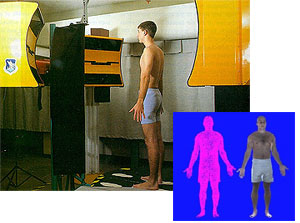
Rapid color non-contact surface scanning is now capable of capturing surface data of the human body for surface area measurements and was used to determine the surface areas of human volunteers. These results were then compared with estimates from Dubois and Dubois, Brody, and Haycock.
Rapid color non-contact surface scanning was used to capture human body topography for 28 women and 24 men selected based on their weight-to-stature and sitting height-to-stature ratios designed to meet United States Air Force aircrew entrance
Rapid color non-contact surface scanning is now capable of capturing surface data of the human body for surface area measurements and was used to determine the surface areas of human volunteers. These results were then compared with estimates from Dubois and Dubois, Brody, and Haycock.
Rapid color non-contact surface scanning was used to capture human body topography for 28 women and 24 men selected based on their weight-to-stature and sitting height-to-stature ratios designed to meet United States Air Force aircrew entrance
requirments. scanning apparel consisted of latex caps to cover the hair, cotton biker shorts, and a sports bra for women. The scanning posture was standing. Anthropometry consisted of 37 measurements per subject including height and weight. Demographics were recorded. Post processing was conducted on the topographic data and the three-dimensional image was used to calculate surface area for each subject.
Surface scanning and post processing were also conducted on a geometric object of known dimensions resulting in a measured surface area within 0.055% of the actual. Surface area using predictive equations from the work of Dubois and Dubois, Brody, and Haycock were calculated for each subject.
We used a multivariate analysis of variance (MANOVA) to determine differences in surface area estimates from scan surface area. The Brody method does a significantly (p-value = 0.0001) better job of estimating the scan surface area than does the Dubois method and the Haycock method. On average, the Brody estimate is 2.7% greater than the measured surface area, the Dubois method is 4.9% greater, and the Haycock method is 5.4% greater. Height and weight were found to be the best predictors of surface area, accounting for 99.1 % of the variability in the scan data surface area.
The population represented by this sample meets Air Force aircrew entrance requirements that restrict height and weight. This population includes only 7 minorities and does not include obese or very thin subjects. The Brody method should be compared against scan surface area of subjects not represented in this population including children and infants. These data suggest that the non-contact scanning method is more accurate than the previous formulas for determining the human body surface area. Further studies to test this hypothesis are in progress.
Surface scanning and post processing were also conducted on a geometric object of known dimensions resulting in a measured surface area within 0.055% of the actual. Surface area using predictive equations from the work of Dubois and Dubois, Brody, and Haycock were calculated for each subject.
We used a multivariate analysis of variance (MANOVA) to determine differences in surface area estimates from scan surface area. The Brody method does a significantly (p-value = 0.0001) better job of estimating the scan surface area than does the Dubois method and the Haycock method. On average, the Brody estimate is 2.7% greater than the measured surface area, the Dubois method is 4.9% greater, and the Haycock method is 5.4% greater. Height and weight were found to be the best predictors of surface area, accounting for 99.1 % of the variability in the scan data surface area.
The population represented by this sample meets Air Force aircrew entrance requirements that restrict height and weight. This population includes only 7 minorities and does not include obese or very thin subjects. The Brody method should be compared against scan surface area of subjects not represented in this population including children and infants. These data suggest that the non-contact scanning method is more accurate than the previous formulas for determining the human body surface area. Further studies to test this hypothesis are in progress.
Whole Body Surface Area Measurements Using Non-Contact Surface Scanning, Jennifer Whitestone, Patrick Kealey, MD, Proceedings of the American Burn Association 31st Annual Meeting, Jan/Feb 1999, vol. 20/no.1 part2, Lake Buena Vista, FL.