

 |
 |
 |
 |
 |
Burn Masks

3D Scanning
 |
 |

Products
 |
 |
 |
 |

Information
 |
 |
 |
 |
 |
 |
 |
 |
 |

Quantification of Facial Asymmetry Using 3D Scanning

©2008 Total Contact - All Rights Reserved
Facial trauma often results in morphological changes that impede cosmetic appearance and functional performance. Initial assessment of facial landmarks and properties is crucial in determining medical and rehabilitative interventions. However, the structures of the face are highly mobile and lack points of fixation.
The use of an effective assessment tool can qualify interventions through outcome studies. Assessment of facial asymmetry can be measured quantitatively through non-contact surface scanning.
The use of an effective assessment tool can qualify interventions through outcome studies. Assessment of facial asymmetry can be measured quantitatively through non-contact surface scanning.
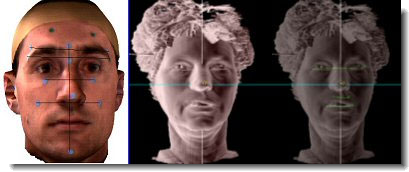
Accurate, high-resolution surface data were acquired for healthy subjects (n=30) and for patients who had received burns or other trauma to the face (n= 15). Three-dimensional coordinates of facial anatomical landmarks were recorded and include right and left tragion, sellion, right and left inframalar, right and left ectocanthus, right and left gonion, and menton.
Soft tissue landmark coordinates were recorded and include right and left philtrum, right and left chelion, and right and left infrapupil. A plane of symmetry was established by rotating the three-dimensional surface data into a coordinate system based on right and left tragion, pronasale, and sellion.
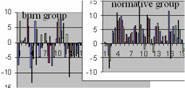
Newly transformed coordinates of the landmarks were resolved for transverse, vertical, and sagittal components. The centroid location was calculated for the soft tissue landmarks for both the normative and burn groups. Bilateral asymmetry was evident in the normative group, revealing that the right side of the face is generally larger than the left side. This degree of right-left dominance measured as a ratio of 1.06 was not found in the facial trauma group and hence, could be used as a threshold of asymmetry.
Bilateral landmark location differences in the vertical and sagittal planes were measured in the facial trauma group. This demonstrates one of the advantages of using three-dimensional surface data. The use of a non-contact scanning demonstrates one of the advantages of using three-dimensional surface data. Facial asymmetry pre and post-surgery can be assessed with greater accuracy andused to monitor outcome studies.
Other measurement techniques for determining the degree of facial asymmetry with surface scans include the use of radial difference maps (RDM), histograms of right-left differences, planar slice measurements, and volume of asymmetry. These techniques will be further developed for this application in future work.
Soft tissue landmark coordinates were recorded and include right and left philtrum, right and left chelion, and right and left infrapupil. A plane of symmetry was established by rotating the three-dimensional surface data into a coordinate system based on right and left tragion, pronasale, and sellion.
Newly transformed coordinates of the landmarks were resolved for transverse, vertical, and sagittal components. The centroid location was calculated for the soft tissue landmarks for both the normative and burn groups. Bilateral asymmetry was evident in the normative group, revealing that the right side of the face is generally larger than the left side. This degree of right-left dominance measured as a ratio of 1.06 was not found in the facial trauma group and hence, could be used as a threshold of asymmetry.
Bilateral landmark location differences in the vertical and sagittal planes were measured in the facial trauma group. This demonstrates one of the advantages of using three-dimensional surface data. The use of a non-contact scanning demonstrates one of the advantages of using three-dimensional surface data. Facial asymmetry pre and post-surgery can be assessed with greater accuracy andused to monitor outcome studies.
Other measurement techniques for determining the degree of facial asymmetry with surface scans include the use of radial difference maps (RDM), histograms of right-left differences, planar slice measurements, and volume of asymmetry. These techniques will be further developed for this application in future work.
Quantification of Facial Asymmetry Using Rapid Non-Contact Surface Scanning, Jennifer J. Whitestone, Alex Lopez, Robert L. Sheridan MD, Proceedings of the American Burn Association 34th Annual Meeting, April 2002, vol. 23/no. 2, Chicago, IL.