


 |
 |
 |
 |
 |
Burn Masks

3D Scanning
 |
 |

Products
 |
 |
 |
 |

Information
 |
 |
 |
 |
 |
 |
 |
 |
 |

Estimation of Head Mass Properties from CT

©2008 Total Contact - All Rights Reserved
Total Contact, working with Veridian Engineering, proved that medical image data and advanced image analysis can be used to predict mass properties of the human head. In order to accurately model the dynamics of the head and neck in impact and acceleration environments ejection scenarios, we need valid mass properties data for the human head.
The mechanical techniques used to measure the mass properties of segmented cadaveric and manikin heads cannot be used on live human subjects. Total Contact used computed tomography (CT) images to calculate mass properties for 15 cadaveric heads. We segmented the CT data into three tissue types - brain, bone, and skin. We assigned a specific
The mechanical techniques used to measure the mass properties of segmented cadaveric and manikin heads cannot be used on live human subjects. Total Contact used computed tomography (CT) images to calculate mass properties for 15 cadaveric heads. We segmented the CT data into three tissue types - brain, bone, and skin. We assigned a specific
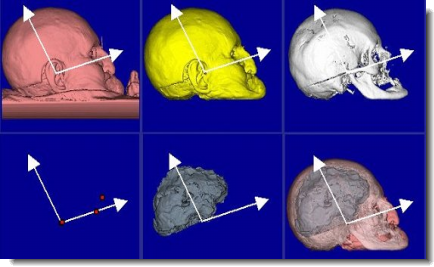
gravity to each volume and, modeling the head, determined the weight, center of gravity (CG), and moment of inertia (MOI)s. Specimen weight, center of gravity (CG), and principal moments of inertia (MOI) were also mechanically measured.
The medical image data compared with the mechanically measured data resulted in the following: 0.4% to 6% (mean = 2.8%) for weight, 0.01 cm to 0.34 cm (mean = 0.1 cm) for the CG, 0.1% to 10.4% (mean = 5.2%) for the MOIs. Medical imaging analysis proved to be a valid and accurate noninvasive method to calculate human head mass properties.
The medical image data compared with the mechanically measured data resulted in the following: 0.4% to 6% (mean = 2.8%) for weight, 0.01 cm to 0.34 cm (mean = 0.1 cm) for the CG, 0.1% to 10.4% (mean = 5.2%) for the MOIs. Medical imaging analysis proved to be a valid and accurate noninvasive method to calculate human head mass properties.
Albery, C.B., Whitestone, J.J, Comparison of Cadaveric Human Head Mass Properties: Mechanical Measurement vs. Calculation from Medical Imaging,Thirty-First International Workshop on Human Subjects for Biomechanical Research, San Diego, CA, October, 2003.