


 |
 |
 |
 |
 |
Burn Masks

3D Scanning
 |
 |

Products
 |
 |
 |
 |

Information
 |
 |
 |
 |
 |
 |
 |
 |
 |

Investigation of the Rule of Nines Using 3D Scanning

©2008 Total Contact - All Rights Reserved
Total burned surface area (TBSA) is a primary measure used in critical treatment decisions for the resuscitation of the burn patient. Often, TBSA is estimated by using the" Rule of Nines" which divides the major anatomic body surfaces into areas that are multiples of nine. High-resolution surface scanning technology can now be used to examine the accuracy of these assumptions with current population data.
Three-dimensional surface scanning technology is a non-contact system that rapidly, in 15 seconds, and accurately captures the contours of the human shape at approximately a 3 mm resolution.
Whole body surface scans were recorded for ten adult male volunteers. The data were edited including interpolation of void areas (i.e., bottom of the feet) to completely represent the human body surface. The
Three-dimensional surface scanning technology is a non-contact system that rapidly, in 15 seconds, and accurately captures the contours of the human shape at approximately a 3 mm resolution.
Whole body surface scans were recorded for ten adult male volunteers. The data were edited including interpolation of void areas (i.e., bottom of the feet) to completely represent the human body surface. The
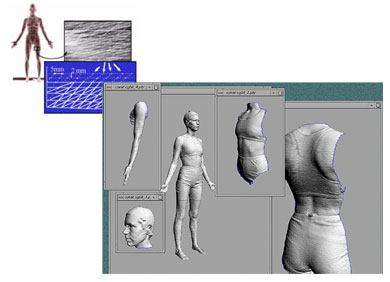
surface scan data were segmented into right and left sides, including posterior and anterior segments according to the segmentation definitions of DuBois and DuBois. A polygonal mesh was constructed using the coordinate point data. A summation of the surface area for all polygonal elements was determined for each body segment.
Results: The contributions of the head/neck segment, anterior trunk (with perineum at an additional 1 %), and posterior trunk are less than the multiples of nine (8.2 + 0.8%, 15.6 + 1.0%,16.6 + 1.4%, respectively). Contributions from the arm and leg segments are more than estimated by the Rule of Nines (10.3 + 0.4% and 20.1 + 0.7%).
Conclusions: Surface scanning technology now exists to further examine surface area measurements of the human body including the pediatric population.
Results: The contributions of the head/neck segment, anterior trunk (with perineum at an additional 1 %), and posterior trunk are less than the multiples of nine (8.2 + 0.8%, 15.6 + 1.0%,16.6 + 1.4%, respectively). Contributions from the arm and leg segments are more than estimated by the Rule of Nines (10.3 + 0.4% and 20.1 + 0.7%).
Conclusions: Surface scanning technology now exists to further examine surface area measurements of the human body including the pediatric population.
An Investigation of the Rule of Nines Using Three-Dimensional Surface Scans, Jennifer J. Whitestone, Proceedings of the American Burn Association 35th Annual Meeting, March/April 2004, vol. 25, No. 2, Miami Beach, FL.