

 |
 |
 |
 |
 |
Burn Masks

3D Scanning
 |
 |

Products
 |
 |
 |
 |

Information
 |
 |
 |
 |
 |
 |
 |
 |
 |

Whole Body Anthropometry for the Design of Farm Tractor Operator Stations

©2008 Total Contact - All Rights Reserved
In a previous study, the body dimensions of 99 subjects – 87 male and 12 female – were recorded using both traditional methods (e.g., caliper measurements) and a state-of-the-art rapid whole body surface scanner. Of these 99 subjects, using multivariate modeling, 14 body sizes were identified as representing large variations in body proportions plus a model representing the mean (centroid). We examined dimensions of the original subjects and identified 15 subjects who scored as “nearest neighbors” and asked them to return to participate in the current study. An actual tractor with roll-over protective structure was rented and the workstation electronically captured using the Faro arm, a portable multi-axis digitizing arm. We decided to emulate the two postures that are currently recommended for human factors design in tractors workstations. A total of 52 anatomical landmarks on 15 subjects, posed in the two different postures, were measured in the tractor’s seat, recording three-dimensional (3-D) coordinates of the landmarks. By linking anatomical landmarks of these specific subjects with the tractor workstation, critical tractor design tools were developed. Using feature envelopes, point cloud data representing a subset of 14 anatomical landmarks, believed to be key for workspace design, were analyzed using principal component analysis, summarizing the data in terms of Cartesian coordinates for the mean location or centroid; orientation of the principal axes; and semi-axis lengths describing ellipsoids of 95% and 99% accommodation.
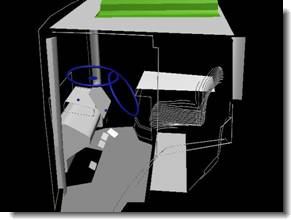
The tractor workstation was captured digitally to record the framework upon which the population data was mapped. The resulting CAD tools include 95% confidence level ellipsoidal feature
The tractor workstation was captured digitally to record the framework upon which the population data was mapped. The resulting CAD tools include 95% confidence level ellipsoidal feature
Bradtmiller B, Gross M, Whitestone J and Lafferty C (September 2002) Whole Body Anthropometry For The Design Of Farm Tractors And Roll-Over Protective Structures (ROPS). Prepared under Contract No. 200-200-08007.
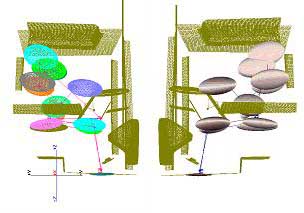
envelopes for each of the key anatomical landmark locations within the tractor workspace. Total Contact has used a culmination of methodologies developed in the last few years for the advancement of human factors design including statistical techniques that have helped to create efficient and accurate representation of population anthropometric data within a workstation environment; linking anthropometry data with digitized equipment models; and revolutionizing design methodologies for creating workspaces such as the tractor operator station and ROPS.